
Kamis, 09 Juni 2011
Menghitung Harga PLTS
Kalkulasi $/kWh dari sistem PLTS ini melibatkan dua komponen, yaitu:
1. Upfront cost: harga yang harus dibayarkan untuk pemasangan sistem PLTS di awal.
2. Life cycle cost: harga yang harus dikeluarkan agar sistem dapat beroperasi dalam jangka waktu tertentu (misalnya selama 20 tahun). Life cycle cost yang paling utama adalah battery. Jika batery dapat bekerja dalam jangka waktu 4 tahun, maka dibutuhkan 5 kali penggantian batery agar sistem dapat beroperasi selama 20 tahun.
I. PERHITUNGAN UPFRONT COST
Untuk sistem PLTS off-grid, komponen upfront cost terdiri dari harga inverter (atau inverter + charger), harga panel, dan harga baterai. Perhitungan masing-masing komponen adalah sebagai berikut:
1. Harga inverter/charger ~ $ 1000/kW
2. Harga solar panel ~ $ 2000/kW
3. Harga battery (upfront cost) ~ $ 1000/kW
4. Harga lain-lain (kabel, box, frame) ~ $ 1000
Total upfront cost ~ $ 5000 / kW
II. PERHITUNGAN LIFE CYCLE COST
Komponen utama life cycle cost adalah battery. Untuk masa operasi 20 tahun, diasumsikan terjadi pergantian batery sebanyak 5 kali, sehingga:
Harga battery (life cycle cost) = 5 * $1000 = $ 5000
Total Life cycle cost = Harga inverter/charger + harga solar panel + harga battery (life cycle cost) + harga lain2 = Total Life cycle cost = $ 1000 + $ 2000 + $5000 + $ 1000 = $ 9000
Perhitungan selanjutnya adalah menentukan total kWh yang digunakan selama sistem bekerja. Dengan menggunakan asumsi sistem bekerja selama 20 tahun dan energi yang digunakan adalah E_used, maka:
Total kWh = 20 tahun * 365 hari * E_used = 7300 * E_used
Jika untuk sistem yang mampu menghasilkan daya maksimum sebesar 1 kW, energi yang digunakan diasumsikan sebesar 5 kWh, maka:
Total kWh = 20 tahun * 365 hari * 5 kWh = 36500 kWh
Dari data-data ini, maka perhitungan $/kWh dapat dihitung sebagai berikut:
Cost_kwh = (Total life cycle cost) / (total kWh) = ($9000) / (36500 kWh) = $0.24/kWh atau 24 sen/kWh.

Sabtu, 14 Mei 2011
SYSTEM PLANNING SOLAR TECHNOLOGY
 The following documents and design tools are aimed at electricians, solar technicians, and professional planners. They offer interesting additional information for all relevant questions regarding the planning of PV systems.
DIRECT CURRENT ( DC ).
Ground connection for thin-film modules and back-contact PV modules
String fuses/reverse current
Module technology
Discharge currents
SOLAR INVERTERS.
Product overview
Texts for Invitation
- Text for invitation of Sunny Boy / Sunny Mini Central / Sunny Tripower (XLS)
System design
- Sunny Design (to product page)
- Capacitive Discharge Currents - Information on the system layout for transformerless inverters (PDF)
Grid interface
Installation
- Mounting on wooden surfaces (limitations for mounting on wood for PV inverters Sunny Boy and Sunny Mini Central) (PDF)
- Temperature Derating (PDF)
- Overview of the compatibility between common grid forms and SMA inverters (PDF)
- Lightning protection and surge protection (PDF)
- Shade management - Efficient operation of partially shaded PV plants with OptiTrac Global Peak (PDF)
- Advisory Guide String inverters - Decentralized Inverter Technology in Large-Scale PV Plants (PDF)
Measuring accuracy
Electromagnetic (Environmental) Compatibility
ALTERNATE CURRENT.
Grid connection
- Reactive Power and Grid Integration with SUNNY MINI CENTRAL and SUNNY TRIPOWER (PDF)
- Requirements for the AC device connection for Sunny Mini Central 9000TL/10000TL/11000TL (PDF)
- Influence of grid properties on the connected power of PV inverters (PDF)
- Dimensioning of suitable line circuit breakers for inverters subject to PV-specific influences (PDF)
- Use of residual current devices (PDF)
- Three-phase grid connection with Sunny Mini Central (PDF)
Power calculations
Senin, 02 Mei 2011
Solar Energy Advantages Disadvantages
This page is a review of the technological and economical of solar energy advantages disadvantages. The advantages get a lot of publicity, to balance the picture the disadvantages and limitations are highlighted.
Advantages of Solar Energy
In this section I will discuss the solar energy advantages, disadvantages will be discussed in the next paragraph. The advantages are:
- Residential solar power generators are silent.
- Photovoltaic generating systems have no moving part therefore they require a very low maintenance effort, they are reliable and the life expectancy of solar generators can exceed 20 years.
- Domestic solar electricity generation systems do not emit polluting gases and do not produce carbon dioxide. It is expected (we already see the initiatives in Europe) that taxes will be imposed on carbon dioxide emissions. You can preempt these future carbon dioxide taxes by installing a residential solar power system and a domestic solar powered hot water heater.
- Once the initial investment is covered, electricity supply from the solar generator is effectively free of charge. Based on the last decade trend and with the political turmoil in the Middle East, it is expected that utility electricity will be more and more expensive in the future to reflect the higher prices of fuel; therefore securing a free of charge electricity during the expected future escalation of energy prices is really a benefit
Advantages of Solar Energy
In this section I will discuss the solar energy advantages, disadvantages will be discussed in the next paragraph. The advantages are:
- Residential solar power generators are silent.
- Photovoltaic generating systems have no moving part therefore they require a very low maintenance effort, they are reliable and the life expectancy of solar generators can exceed 20 years.
- Domestic solar electricity generation systems do not emit polluting gases and do not produce carbon dioxide. It is expected (we already see the initiatives in Europe) that taxes will be imposed on carbon dioxide emissions. You can preempt these future carbon dioxide taxes by installing a residential solar power system and a domestic solar powered hot water heater.
- Once the initial investment is covered, electricity supply from the solar generator is effectively free of charge. Based on the last decade trend and with the political turmoil in the Middle East, it is expected that utility electricity will be more and more expensive in the future to reflect the higher prices of fuel; therefore securing a free of charge electricity during the expected future escalation of energy prices is really a benefit
Jumat, 15 April 2011
Off-Grid Solar Power System
This system will deliver a maximum of 180 watts/15 amps of power via each of two 12-volt cigarette lighter sockets, 140-150 watts of continuous 120VAC/60Hz pure sine wave power via a power inverter, and is wired and fused accordingly. The maximum combined deliverable power at any given moment is approximately 300 watts, limited by the drop in the battery voltage at a discharge current of approximately 25 amps, and is protected against over-current by a 30-amp ATC fuse. If the combined power draw of your electronic devices is 60 watts, the battery will last approximately 4 hours in the absence of incoming solar power before it needs to be recharged, longer if the power draw is less. If the current draw from either of the cigarette lighter sockets exceeds 15 amps, a 15-amp ATC fuse will blow, and will need to be replaced (simple to do; extras included). If the power draw from the inverter exceeds its continuous or surge wattage ratings, it will turn off, and then will need to be re-set (switch inverter power button off, then back on), or a 20-amp ATC fuse will blow and will need to be replaced (extras included).
The battery, solar charge controller, power inverter, 12-volt DC power distributor, wiring, and accessories are housed in a water-, crush-, and dust-proof, protective carrying case in black. The power system components are secured and padded inside the case by custom-configured cubed foam. The solar panel remains outside of the case. Off-Grid Solar Power System - #1 comes with:
The case measures 18.50 x 14.06 x 6.93 inches in external dimensions, and the entire system weighs approximately 37 pounds.
This system will deliver a maximum of 180 watts of power/15 amps via each of two12-volt cigarette lighter sockets (limited by 15-amp fuses), 150 watts of continuous 120VAC/60Hz power via an inverter (limited by the inverter circuitry), and is wired and fused accordingly. The maximum combined deliverable power at any given time is 360 watts/30 amps, and is limited by a 30-amp ATC fuse. If the combined power draw of your electronic devices is 60 watts, the battery will last approximately 3.5-4 hours in the absence of incoming solar power before it needs to be recharged, longer if the power draw is less. If the power draw from either of the cigarette lighter sockets exceeds 180 watts, a 15-amp ATC fuse will blow, and will need to be replaced (simple to do; extras included). If the power draw from the inverter exceeds its continuous or surge wattage ratings, it will turn off, and then automatically reset itself, or a 20-amp ATC fuse will blow and will need to be replaced (easy to do; extras included).
The battery, solar charge controller, power inverter, 12-volt DC power distributor, solar panel, wiring, and accessories are housed in a water-, crush-, and dust-proof, protective carrying case in yellow. The power system components are secured and padded inside the case by custom-configured foam. Off-Grid Solar Power System - #2 comes with:
Kamis, 31 Maret 2011
Smarter Metering
Technologies for T&D Networks
“Smart metering” has demonstrated how advances in technology may be used to solve a utility's changing needs in a dynamic market- place. But where smart metering is effective at the end-customer metering point, new technologies in multifunction “smarter meters” provide a broader range of benefits at any metering point within a utility network.
This paper describes how new communications technologies including local mastering, gateway functionality, web based presentment, e-mail data transfers and Ethernet support of SCADA protocols have been used by power utilities around the world to provide integrated network control and monitoring.
With these technologies, communications costs to remote substations are drastically reduced while still increasing the number of monitored points and improving network awareness. It is shown how these communication links can provide billing data, operational data to supervisory control and data acquisition (SCADA) systems, and regulatory compliant power quality information so that the needs of multiple departments are met within a single device.
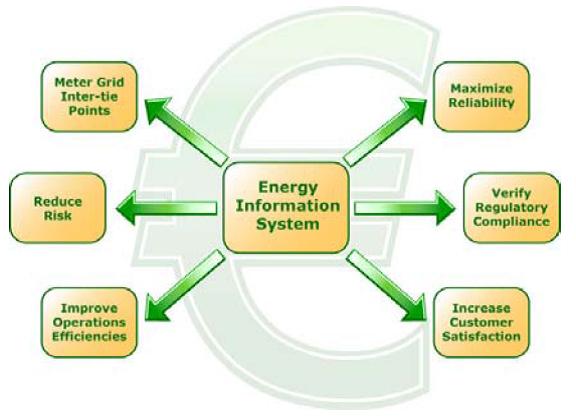
Finally, case studies are presented that illustrate how utilities leverage smarter meters to automate tasks such as local aggregation and advanced transformer compensation to simplify network analysis and billing. By providing distributed intelligence, local control and the communications infrastructure to reach more metering points, Smarter metering enables utilities to increase awareness, reduce risk, and lower operational costs.
I. History of Smart Metering
Since the introduction of solid-state metering in the early 1990s, features have been added to tariff meters to provide more valuable information to electric utility companies than simple energy accumulation.
Multifunction meters register active, reactive and apparent energy, time-of-use (TOU) meters track energy consumption at different tariff rates, and remote communications options (fixed network or wireless) have been added for automated meter reading (AMR). A device with the embedded intelligence required to offer these combined features has often been dubbed a “smart meter”.
Smart metering is typically applied at the end customer metering point, be it industrial, commercial or residential, and primarily for billing purposes only. While this covers the largest number of monitoring points in a utility’s network, no additional features are provided where energy flows are largest and operational data is most critical: within the transmission and distribution network.
Recently, “smarter”, more powerful meters have begun to emerge that offer better interface technologies. These provide access to more information than their earlier “smart” counterparts:
SCADA data, power quality and reliability data, loss calculations and error correction, and other troubleshooting data. These new communication technologies can be used to connect to remote mission critical transmission and distribution (T&D) stations, or between devices within these stations.
II. New Communication Technologies
To the substation:
Slow, not broadband, power line carrier (PLC) and serial data modem lines have long been used for remote access to substation data. While effective for basic SCADA telemetry, these media are limited to relatively low throughput rates, generally below 9600 bps. Capacitor traps for PLC systems are expensive to install and maintain, and modem lines are susceptible to electro magnetic noise leading to suboptimal communication rates. For both of these traditional media, complex data types such as digital waveform recordings lead to long connection times and limit a utility’s ability to read all of their installed meters in a timely fashion.
With the growth of wide area networks and the world-wide web, TCP/IP has emerged as a high throughput transportation mechanism suitable for many new media and embedded protocols. Ethernet connections (either twisted pair copper or fibre optic) provide dedicated 10 or 100 Mbps channels capable of addressing all devices within a substation simultaneously. With a data transfer rate 1000 times faster than dial-up modem, TCP/IP can support complex data types without introducing communications bottlenecks. Fibre optic links provide the additional benefit of galvanic isolation, removing a potential failure point from the system.
For remote substations, TCP/IP can be utilized over satellite radio links or broadband power line carrier. In either case, the telecommunications industry has provided the necessary equipment to transmit and decode these signals, simplifying installation and removing integration conflicts.
The TCP/IP address of the end device is all that is needed to configure the system. Finally, email may be used as a transportation mechanism. Relying on TCP/IP for transmission of the individual packets, e-mail allows data to flow seamlessly through firewalls without compromising security.
The information technology (IT) industry has developed systems to accommodate the flow of email traffic while maintaining the security of their networks. Email is preferred in many cases by IT departments than TCP/IP connections alone because of the enhanced security it offers. Smarter meters supporting TCP/IP provide access to all of these communication architectures and the development efforts of the entire communications industry.
Within the substation:
Ensuring a high throughput communications pipeline to the substation is the highest priority in ensuing timely access to metering data. But within the substation, new technologies are also present to reduce the installation cost and improve access to other substation devices.
Ethernet and modem gateways allow one smarter meter to act as a communication hub, routing messages to other devices in the substation over inexpensive RS-485 serial connections (Figure 1). 1). Using such an architecture, only one device needs to be equipped with either the Ethernet or modem hardware, reducing the overall cost of the metering equipment and allowing access to 32 downstream devices or more. When using an industry standard protocol such as Modbus or DNP, the downstream devices are unaware that the request has been passed through a gateway and behave as though communicating directly to the master software or RTU. Older devices can thus be integrated into a newer communications architecture.

Figure 1. Using gateways to communicate with devices inside a substation.
Another means of integrating legacy devices is through local mastering. In this application, a smarter meter is used as an RTU; requesting information from other devices and passing it backbup to the master software. This opens up possibilities for local data control, such as aggregating feeder readings from multiple devices before transmission back to the master software.

Figure2. New communication technologies simplify collection of data from existing and new substation devices.
III. Extended Interoperability and Data
Access New communication technologies can solve many problems related to data acquisition and speed, but the benefits to utilities are only realized if the information is presented in a ready to use format. Integration with existing utility systems is key to meeting this need.
For each user, system or department, smarter meters present information in the appropriate format over appropriate media. SCADA and Operations systems require industry-standard protocols such as IEC 61850, IEC 60870-5-101, DNP or Modbus. Various device vendors make these protocols available over TCP/IP for high speed direct integration into existing SCADA systems.
Billing systems may require information on energy consumption or demand in protocols such as DLMS, IEC 60870-5-102 or MV90. Again, some software vendors now support data acquisition over TCP/IP using these protocols. In addition to these more traditional uses of data, key account managers may wish to view load profiles, power quality information or alarm conditions. For each of these, the data format and media is customizable, ranging from pager alerts to emailed reports, to web-accessible graphical views.
Finally, other utility departments may wish to view the information contained in a smarter Mmeter. By providing a secure web server on the device, authorized persons can view critical information in real-time from any computer any where in the world .
IV. Case Studies
Using Ethernet to provide data to multiple users
After liberalization, a major utility needed to provide daily settlement data to the independent system operator (ISO). The utility chose smarter meters with TCP/IP support and gateway functionality. Forty gateway meters connected to the existing Ethernet wide area network provided high-speed access to over 260 new tariff meters.
By using TCP/IP, there is no concern that the utility or ISO data retrieval will interfere with each other and the utility network now supports complex power quality data at any of its monitoring points.
Using satellite to overcome geographical challenges
An electrical utility with a 70,000 square kilometre service area needed access to remote substation data. Due to limited existing infrastructure, TCP/IP over satellite links provides access to real-time SCADA data. Transient events, sag/swell events and transformer loading alarms for the substation are sent by e-mail over satellite to PCs and pagers.
Using local mastering to increase efficiency
Managers at a switchyard needed combined instrument / transformer loss compensation and power factor monitoring, plus aggregation and scaling of real-time data. By monitoring transformer and instrument losses on the secondary side, installation costs are reduced without sacrificing accuracy.
The switchyard is a 500kV transmission facility with 10 bays, handling power flowing to and from four different independent power producers, a nuclear facility, and several other substations. Substation bays operate as four loops, with smarter meters configured as Mod-bus Master devices, each gathering real-time data from its loop to perform scaling and aggregation before passing values to a central RTU.
The network fully integrates with the existing billing system and provides a valuable backup function if the RTU or communication links fail, the data can be retrieved manually from the onboard non-volatile memory of each meter. When generators go online and merchant sites produce their own power, the breakers close and the meters go offline.

V. Conclusion
Applying the new technologies of the telecommunications industry to metering systems allows utilities to increase network awareness and control. Combining these technologies with powerful multi-function metering platforms provides opportunities for utilities to reduce operational risk, solve business needs, and improve network reliability.
Rabu, 23 Maret 2011
Executions Project Sample
PROJECT: ENERGY MONITORING & PRODUCT LOADING SYSTEM
FEATURES:
- Web based platform to launch an application that would monitor the daily, weakly, monthly energy activity.
- Track the Energy consumption for total plants.
- Build a secure log in the web that can be accessed by company management personnel
- Connectivity; modbus TCP/IP providing high data transfer rate 10/100mbps over 1 to 1.5 Km.

SCHEME:
The entire Energy monitoring System comprises of various meters (includes different makers) to measure Electrical Energy Parameters like Kwh, Current, Voltage that need to be monitored & logged by a SCADA System. The system acquired data thro’ Modbus TCP/IP converter.
PROJECT : UTILITY AUTOMATION
FEATURES :
- Connectivity between Devices and PLC though Profibus PA.
- Connectivity between two different SCADA through OPC server.

SCHEME :
The Utility Automation comprises of various Instruments to measure Process Parameters like FLOW PRESSURE, LEVEL, TEMP and Electrical.
Energy Parameters that need to be monitored by a Centralized SCADA System.
The reports of all these parameters are generated by SCADA.
Total no. of I/Os [no. of parameters] are approx. 500.
PROJECT : TUBE CURING PLANT
FEATURES :
- Multi dropping of 7 PLC.
- Net based Web enabled reports

SCHEME :
The client has 99 tube curing m/cs(provision of 112 m/cs). When operator produce one tube ,he send a DO in terms of pulse of few msec., it will be pick up by PLC. PLC wil compare the frequency with predefined and increase one respective counter of tube production or false pulse as per logic. The SCADA will collect those all values and generate report accordingly.
Total no. of I/Os [no. of parameters] are approx. 500.
PROJECT : STATEWIDE WATER TREATMENT AND DISTRIBUTION NETWORK
FEATURES :
- Connectivity trough WebServer in between two main location one and two.
- Connectivity trough PSTN Network in between head office and main locations.
- Connectivity trough GPRS Network in between main location and remote locations.
- SCADA and PLC Redundancy.

SCHEME :
THERE ARE TWO MAIN LOCATIONS AS 1 & 2 AND 5 REMOTE LOCATIONS AS R1 TO R5 OF WATER TREATMENT AND DISTRIBUTION.
EACH LOCATION HAS DIFFERENT INSTRUMENTS LIKE FLOW , PRESSURE, LEVEL, TEMPERATURE,PH SENSOR AND ELECTRICAL PARAMETERS WHICH ARE MONITORED AT CENTRALISED LOCATION WITH SCADA.
SCADA SOFTWARE HAS REDUNDANCY FEATURE AS WELL AS IT IS POSSIBLE TO VIEW THE SAME INFORMATION FROM PC SITUATED IN HEAD OFFICE CONNECTED THROUGH PSTN NETWORK.
GPRS CONNECTIVITY IS USED FOR ACQUIRING DATA FROM REMOTE LOCATION AT CENTARILSED LOCATION
Langganan:
Postingan (Atom)